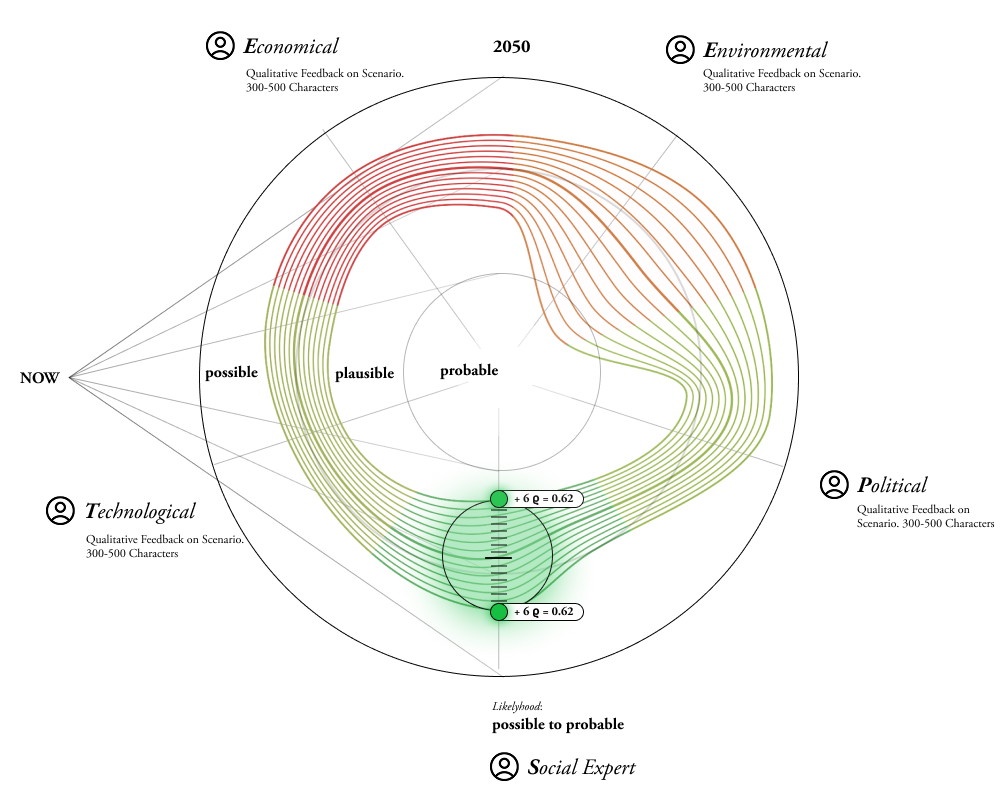
How do we make confident decisions in a world full of uncertainty? Professors Hermann W. Klöckner (Anhalt University, TU Munich) and Caroline V. Rudzinska (Berlin School of Economics and Law) introduce Futures’ Fingerprints, a novel approach for joint scenario assessment in foresight. The method combines interactive boundary objects, AI sparring, and circular visualisation techniques to empower diverse expert groups — enabling them to converge, diverge, and reflect through data-rich, intuitive visual tools.
Futures’ Fingerprints turns abstract foresight into graspable, shared experiences. At its core is an interactive “digital round table” where participants co-create scenario assessments using intuitive visual tools. These fingerprints make divergent expert views visible and negotiable — enabling rich group dialogue, faster convergence, and deeper reflection. This design promotes not just understanding the future, but shaping it together.
Futures’ Fingerprints has been evaluated in a 2024 study with key experts from politics, economy, ecology and social backgrounds and a 2025 study at the Berlin University of Economics and Law, International Strategic Management.It has been peer reviewed and published on HICSS 2025 conference (Hawaiian International Conference of Systems Science) and authored by Prof. Hermann W. Klöckner, Prof. Dr. Caroline Rudzinska, Prof. Dr. Roland M. Mueller and Jonah L. Schierding.
An extension has been presented on the Turku 2025: Futures of Technologies Conference.
Shaping Future-Ready Decisions Through Hybrid Intelligence and Visual Collaboration
Method: Round Table + AI
Making Futures graspable – literally
Method Evaluation
Paper by Klöckner, Rudzisnka, Mueller, Schierding(2025, HICSS)
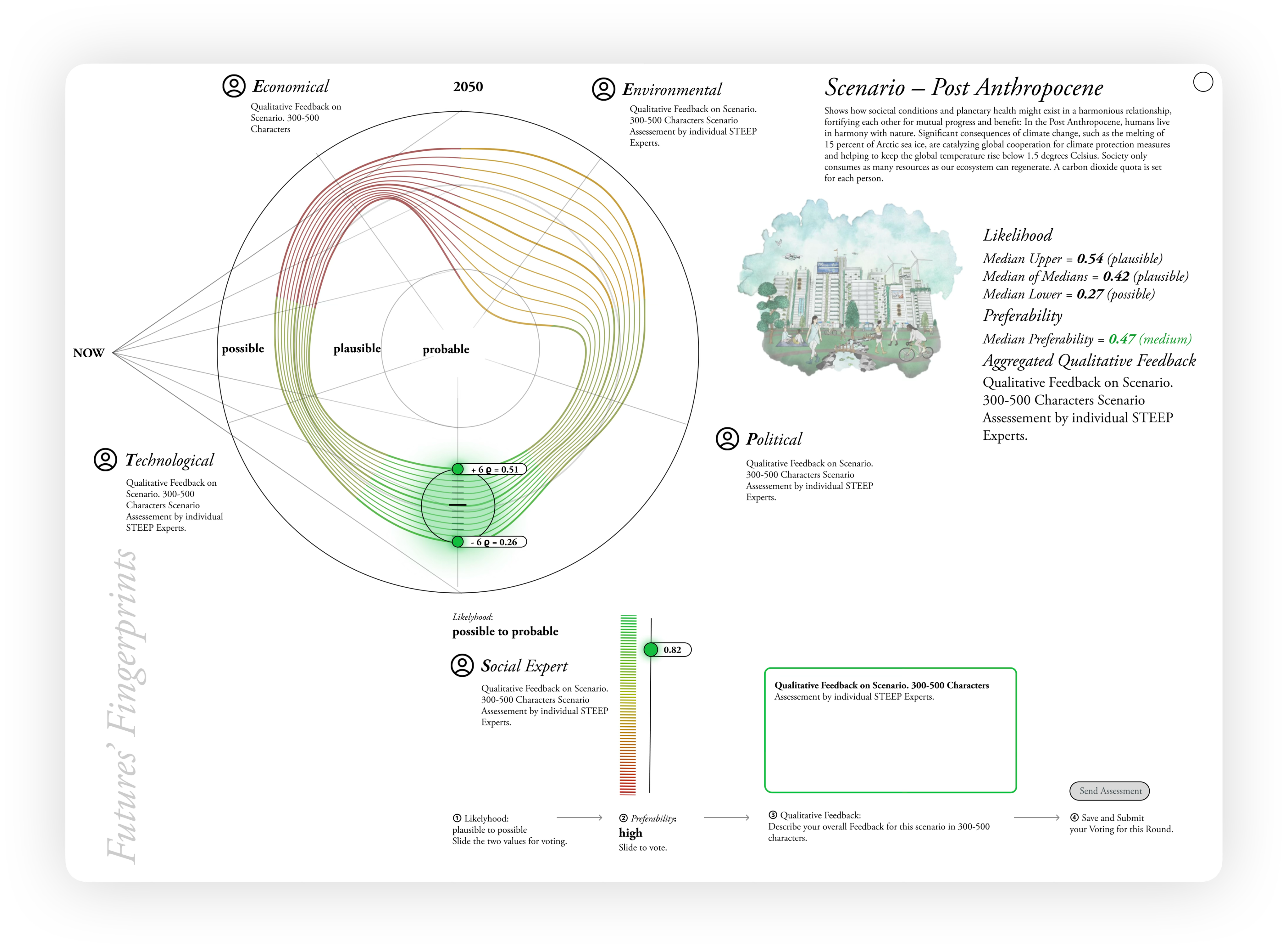


In 2050, cities and nature thrive together. Buildings breathe with plants, energy comes from sun and wind, and people live in harmony with ecosystems. Urban life is slow, green, and shared—with food grown in vertical gardens and mobility designed for walking, cycling, and animal life alike.
Scenario 2050 Human-Nature Co-Living
Software Topology – Joint Scenario Assessment (Augmented Delphi)
Futures’ Fingerprints
A digital round table tool and method for joint Scenario Assessment
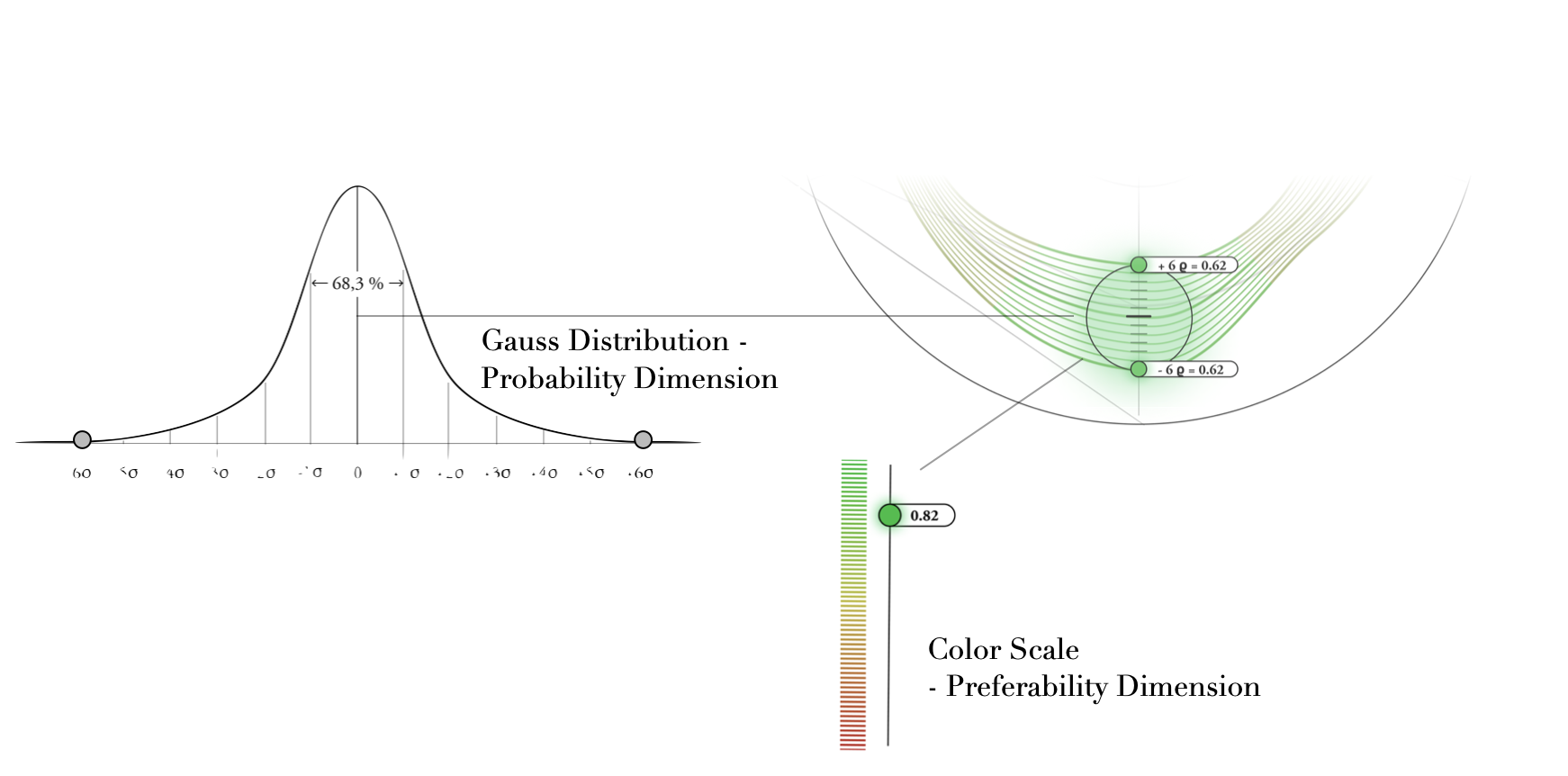
Probability and Preferability Assessment.
Additional dimensions include Utility and Impact.
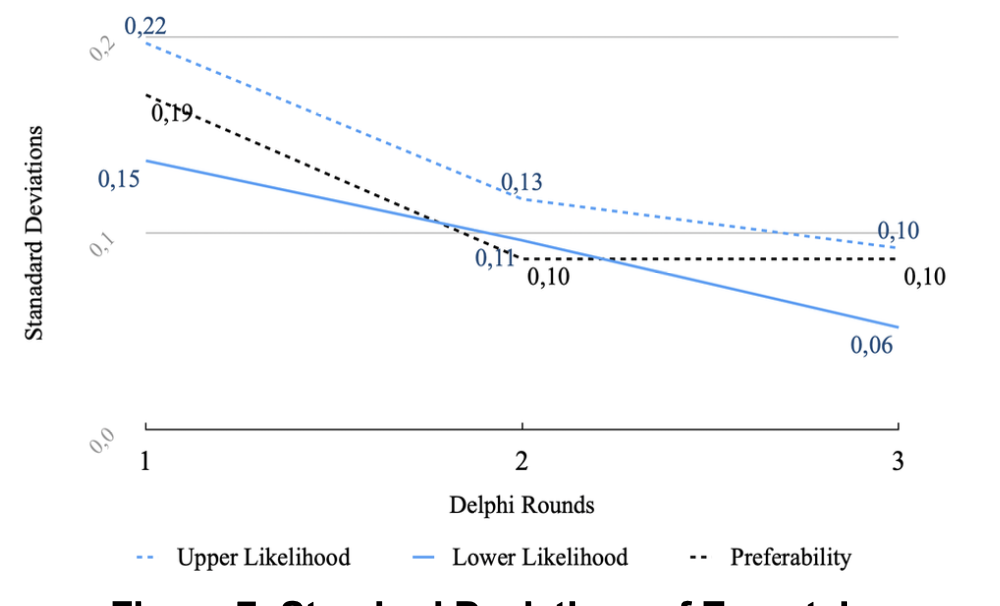
Convergence in Probability and Preferability Assessment.
Get in touch


Impressum
Angaben gemäß § 5 TMG
Prof. Hermann W. Klöckner
Anhalt University of Applied Sciences
Bauhausstraße 5, 06846 Dessau-Roßlau
hwkloeckner@me.com
Prof. Dr. Caroline V. Rudzinska
Berlin School of Economics and Law
Badensche Str. 50–51, 10825 Berlin
caroline.rudzinska@hwr-berlin.de
About
Imprint -Impresszm
Hermann W. Klöckner is Professor of Interaction Design at Anhalt University of Applied Sciences in Dessau (Historical Bauhaus campus) and a partner (30%) at Berlin’s Cavorit Consulting GmbH. He specializes in UX, data visualization, AI-supported interfaces, and digital twins—merging qualitative insight with quantitative modeling to create collaborative tools for industry and the public sector.
At Cavorit, he focuses on smart data strategy and interactive systems for joint decision-making. His project portfolio includes Mercedes-Benz’s JoDA planner, Rolls-Royce’s Virtual Jet Engine, and an AR-based Citizen App for the EU’s New European Bauhaus. His research and practise connects interaction design with systems thinking and foresight, with recent publications at HICSS and Design conferences. He studied at UdK Berlin, held a visiting professorship in Hangzhou, and worked as Senior Art Director at ART+COM. His work has won the iF Gold Award and ADC Bronze Nail and led to several patents.
Rooted in Bauhaus principles, Hermann supports organizations in turning complexity into action through design-driven foresight. He lives in Berlin, balancing research, consultancy, and family life.
Prof. Hermann W. Klöckner

Caroline V. Rudzinska is Professor of Strategic Management at the Berlin School of Economics and Law, Co-Head of the Institute for Sustainability, and Director of the Master’s program in International Business and Consulting. She is also an experienced futures consultant, supporting organizations in anticipating change, shaping resilient strategies, and securing long-term success.
Her expertise spans strategic foresight, sustainability, innovation management, and urban mobility. Before entering academia, Caroline worked in corporate strategy like at Volkswagen, where she contributed to key initiatives such as TRANSFORM 2025+, and advised the European Commission as a recognized expert.
She holds degrees from the University of Witten/Herdecke and Stockholm University, and earned her PhD with highest honors (summa cum laude).
By leveraging deep experience in scenario planning, systems thinking, and strategic foresight, Caroline helps organizations embed future-oriented frameworks into long-term strategies and sustainability agendas — empowering them to not only understand the future, but actively shape it.
Prof. Dr. Caroline V. Rudzinski
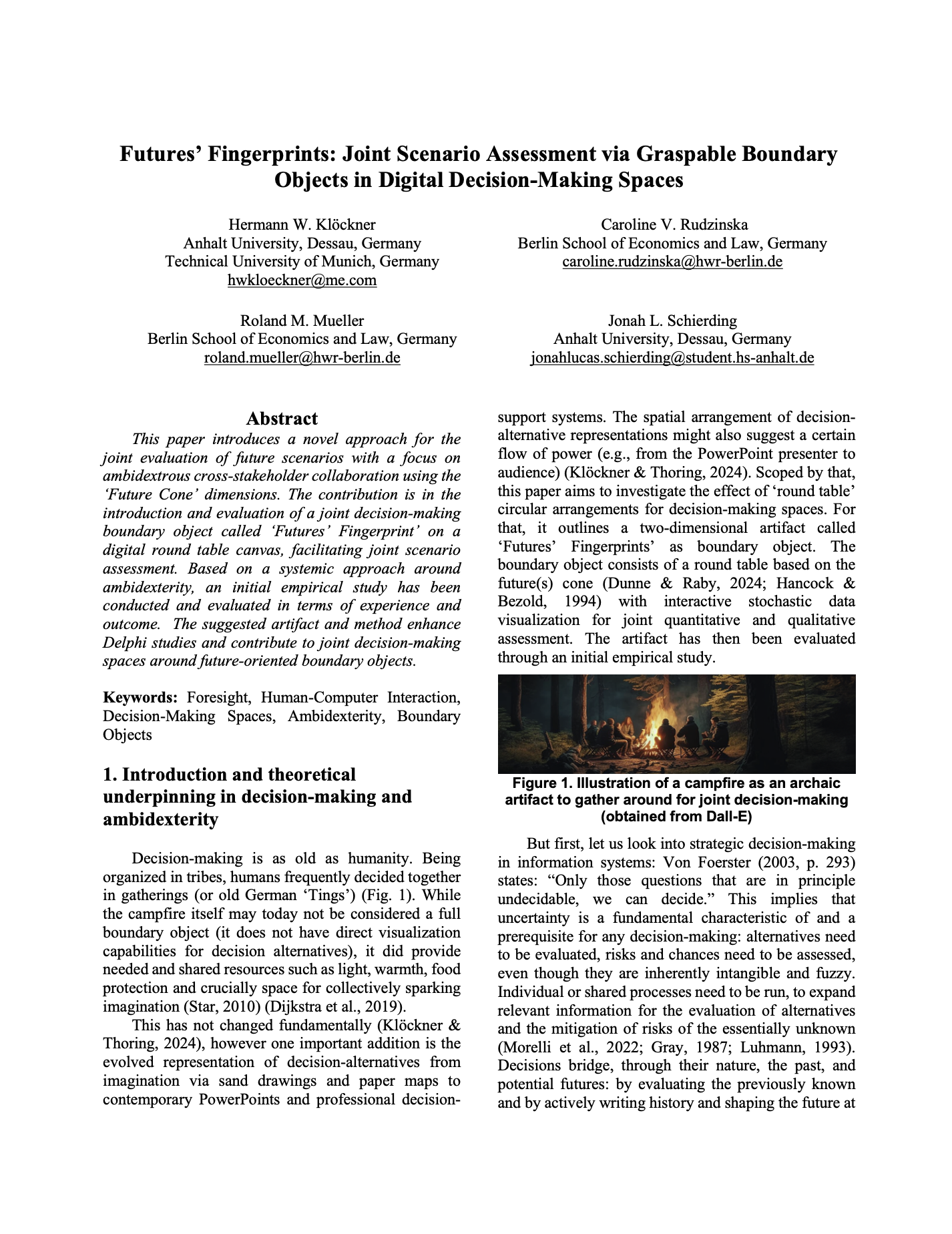
Futures’ Fingerprints blends classic foresight methods such as Delphi, STEEP, and the Future Cone with boundary object visualisation and AI interaction. It introduces circular decision spaces using a round-table metaphor with concentric “Futures Cones” to assess scenario likelihood and preferability. Interactive visualizations called “Fingerprints” serve as boundary objects that enable shared exploration of complex futures. The method encourages ambidextrous thinking by supporting both divergence (exploration) and convergence (decision-making), integrating qualitative insight with quantitative assessment.
Personalised AI agents act as dialectic sparring partners, challenging expert assumptions and expanding perspectives — shifting the process from human-in-the-loop to AI-in-the-loop foresight. Empirically validated with both seasoned and emerging experts, the approach has demonstrated improved scenario convergence and measurable gains in Future Literacy, aligned with UNESCO frameworks.